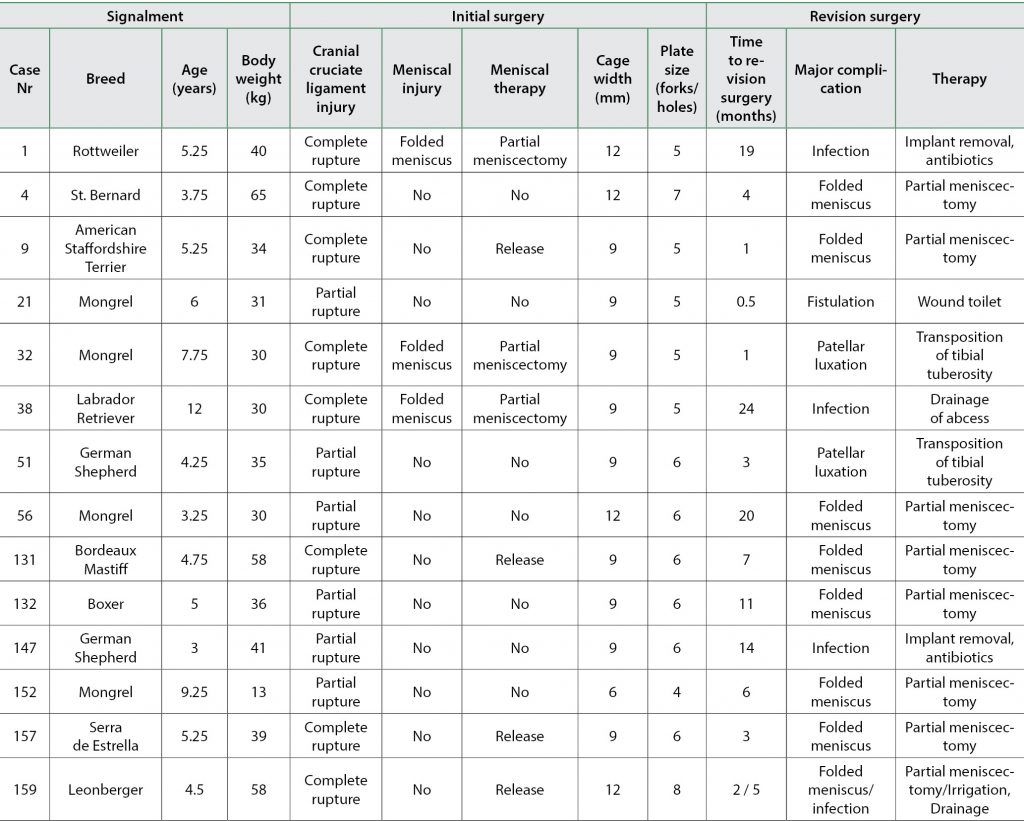
Stopień powikłań po 214 kolejnych zabiegach TTA stosowanych w terapii zerwania więzadła krzyżowego przedniego
Results
The cranial cruciate ligament showed complete rupture in 62.5% of all cases. Partial ruptures were seen in 36%. In one case, the ligament was stretched, but not ruptured. The meniscal status from 210 cases could be retrieved, showing 55.5% intact menisci, 39% had folded and wedged caudal horns of the medial meniscus and 5.5% had various meniscal lesions including bucket-handle tears, partial detachment and transverse tears. In 25%, of 210 cases, the medial meniscus was not treated. Partial meniscectomy was performed in 44%, and a meniscal release was done in 31%. From four surgeries, no information about meniscus treatment could be found.
Major complications were seen in 15 cases of 214 surgeries (table 2, p. 29), leading to a rate of 7%. The most frequent complication was medial meniscal injury (8 cases, 3.75%). In six cases, the meniscus was folded and wedged between the femur and the tibial, in one case the caudal horn was loose and squeezed, and one case was revised in another clinic. In four of these meniscal injury cases, a mid-body meniscal release was performed during the first surgery. All meniscal injury cases were treated by partial meniscectomy.

Ten materiał dostępny jest tylko dla użytkowników
którzy są subskrybentami naszego portalu.
którzy są subskrybentami naszego portalu.
Wybierz pakiet subskrypcji dla siebie
i ciesz się dostępem do bazy merytorycznej wiedzy!
i ciesz się dostępem do bazy merytorycznej wiedzy!
Masz aktywną subskrypcję?
Nie masz jeszcze konta w serwisie? Dołącz do nas



121
ALGORYTMY
POSTĘPOWANIA
w weterynarii
POSTĘPOWANIA
w weterynarii